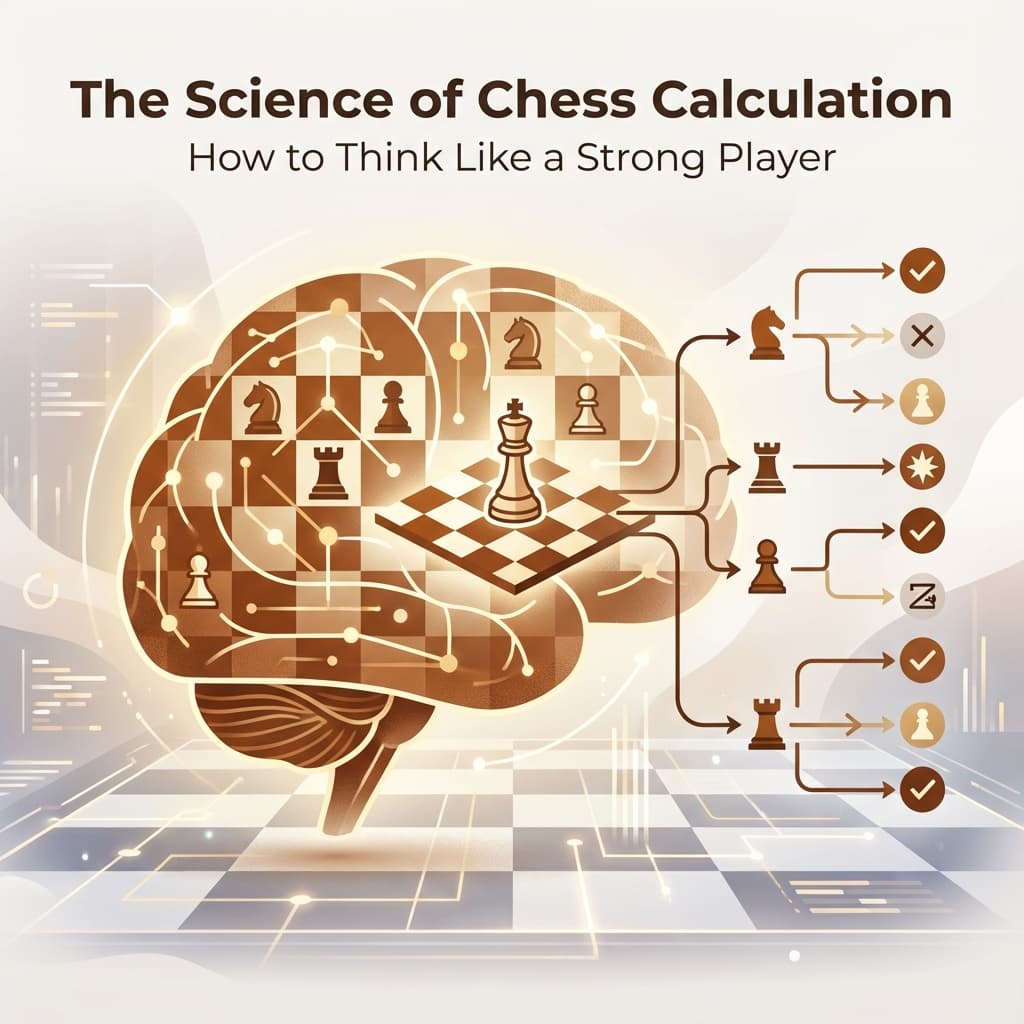
The Science of Chess Calculation: How to Think Like a Strong Player
Watch a strong player think, and you'll notice something remarkable: they don't calculate faster than you—they calculate smarter. While beginners analyze random moves hoping to spot something, masters follow systematic calculation patterns that make finding the best moves feel almost effortless.
This guide breaks down the cognitive process of calculation into actionable steps, helping you stop guessing and start seeing the board clearly.
1. Candidate Moves: The Filter
The Concept: Before you calculate a single variation, you must identify what to calculate.
The Process: Scan the board for forcing moves first:
- Checks: Force the king to move.
- Captures: Change the material balance.
- Threats: Create an immediate problem for the opponent.
The Rule: If you don't look at a move, you can't play it. Wide vision prevents missed opportunities.
2. The Calculation Tree: Width vs. Depth
Width: How many different first moves you consider.
Depth: How many moves ahead you look.
The Mistake: Calculating one line 10 moves deep (Tunnel Vision).
The Fix: Calculate wide first, then deep. Look at 3-4 candidate moves for 2 moves deep. Only when one looks promising should you calculate it further.
3. Visualization Techniques
The Challenge: "I lose track of the pieces in my head."
The Technique: Use "stepping stones." Calculate 3 moves, pause, and visualize the new position clearly. Verify where every piece is. Then calculate 3 more moves from that mental image.
Practice: Solve puzzles without moving the pieces. Do not touch the board until you have seen the entire solution to the end.
4. The Evaluation: The Stopping Condition
When to stop: You stop calculating when the position is "quiescent" (quiet). This means:
- No more checks.
- No more captures.
- No immediate threats.
The Assessment: Once the position is quiet, ask: "Is this better for me than the starting position?" If yes, play it. If no, look for another candidate move.
5. Training Your Calculation
Blindfold Exercises: Try to visualize a board and name the color of specific squares (e.g., "What color is f7?"). This strengthens your mental board.
Study Studies: Endgame studies are pure calculation gyms. They force you to be precise because one wrong move ruins the solution.
Get Feedback: It is hard to know if your calculation process is flawed. A coach can listen to you think out loud and correct your logic in real-time. Platforms like findyourchesscoach connect you with experts who can diagnose your calculation errors and teach you to see the board like a master.
Conclusion: Calculation is a muscle. It hurts to use it at first, but with consistent training, it becomes your greatest weapon.
Ready to Take Your Chess to the Next Level?
Find experienced chess coaches who can help you master the concepts in this article and accelerate your improvement.
Browse Chess CoachesAbout the Author
Find Your Chess Coach ©
The Find Your Chess Coach team consists of chess enthusiasts, developers, and coaches dedicated to connecting players with the best instructors worldwide. We curate content to help chess players improve and find their perfect coaching match.