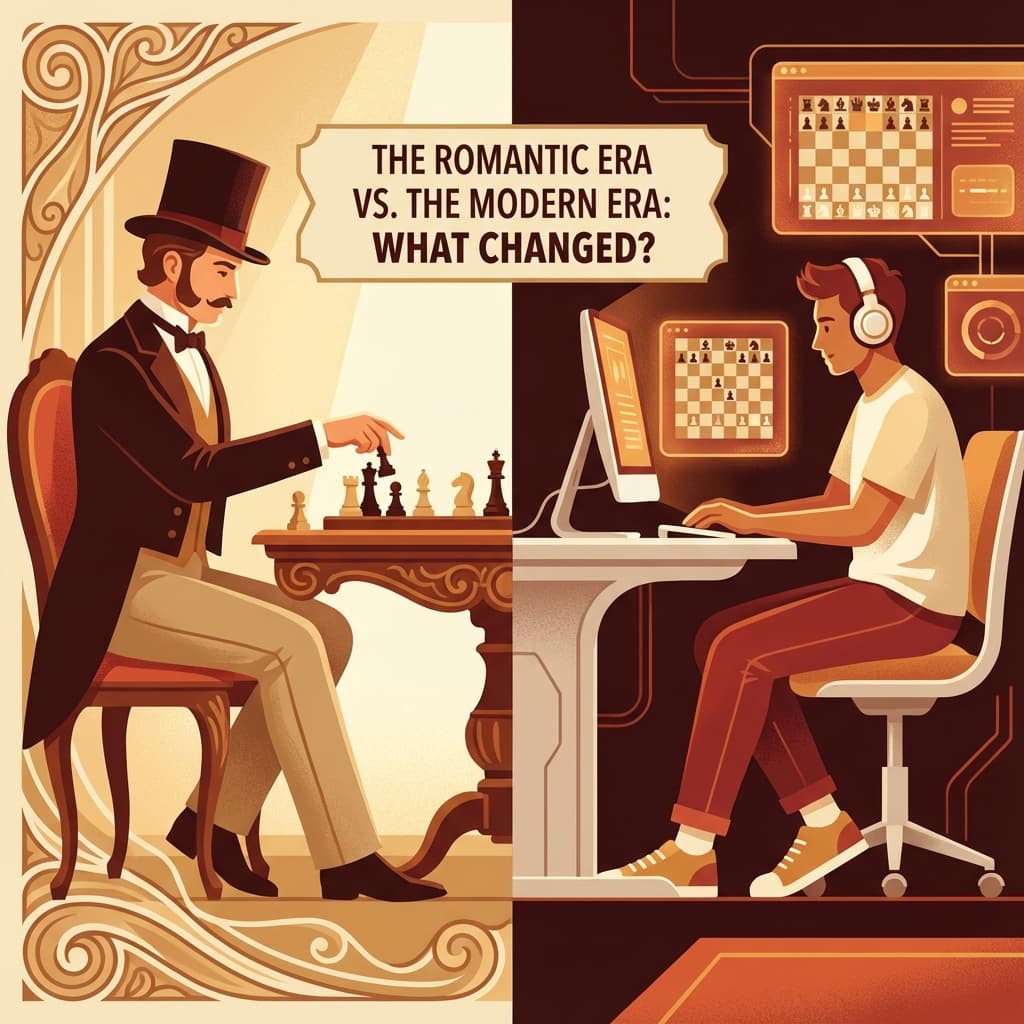
The Romantic Era vs. The Modern Era: What Changed?
In the 19th century, chess was a game of gentlemen, gambits, and glorious sacrifices. Defense was considered cowardly. If you weren't attacking, you weren't playing.
Today, chess is a science. Computers calculate 30 moves deep, and a draw is a respectable result. How did we get from the wild attacks of Paul Morphy to the grinding precision of Magnus Carlsen?
This guide traces the evolution of chess style, helping you understand the history behind the moves you play today.
1. The Romantic Era (1800s): Art Over Science
The Philosophy: Chess was art. The goal was to create a beautiful checkmate, regardless of the cost.
The Style: Open games (1.e4 e5), King's Gambits, and Evans Gambits. Players sacrificed pawns and pieces purely for initiative.
The Icon: Paul Morphy. He proved that rapid development and open lines could crush an unprepared opponent.
2. The Scientific Era (Late 1800s - Early 1900s): The Birth of Strategy
The Shift: Wilhelm Steinitz, the first World Champion, realized that attacks only work if the opponent makes a mistake. He introduced the concept of "accumulating small advantages."
The New Rules: Control the center, create weak pawns, and don't attack until you have a positional advantage.
3. The Hypermodern Era (1920s): Controlling from Afar
The Revolution: Nimzowitsch and Reti challenged the dogma that you must occupy the center with pawns. They proved you could control it with pieces from the flanks (fianchettoed bishops).
The Legacy: Openings like the King's Indian Defense and the Reti Opening were born.
4. The Computer Era (1990s - Present): Concrete Calculation
The Machine: Engines proved that "general principles" have exceptions. Sometimes you can move the same piece twice in the opening. Sometimes you can leave your king in the center.
The Modern Style: Universal. Top players today can play like Romantics or Scientists depending on the position. They are pragmatic, resilient, and brutally accurate.
Conclusion: Understanding chess history isn't just trivia. It helps you understand why we play the way we do. Every time you fianchetto a bishop, you are paying homage to the Hypermoderns. Every time you sacrifice a pawn for an attack, the spirit of Morphy smiles.
Ready to Take Your Chess to the Next Level?
Find experienced chess coaches who can help you master the concepts in this article and accelerate your improvement.
Browse Chess CoachesAbout the Author
Find Your Chess Coach ©
The Find Your Chess Coach team consists of chess enthusiasts, developers, and coaches dedicated to connecting players with the best instructors worldwide. We curate content to help chess players improve and find their perfect coaching match.