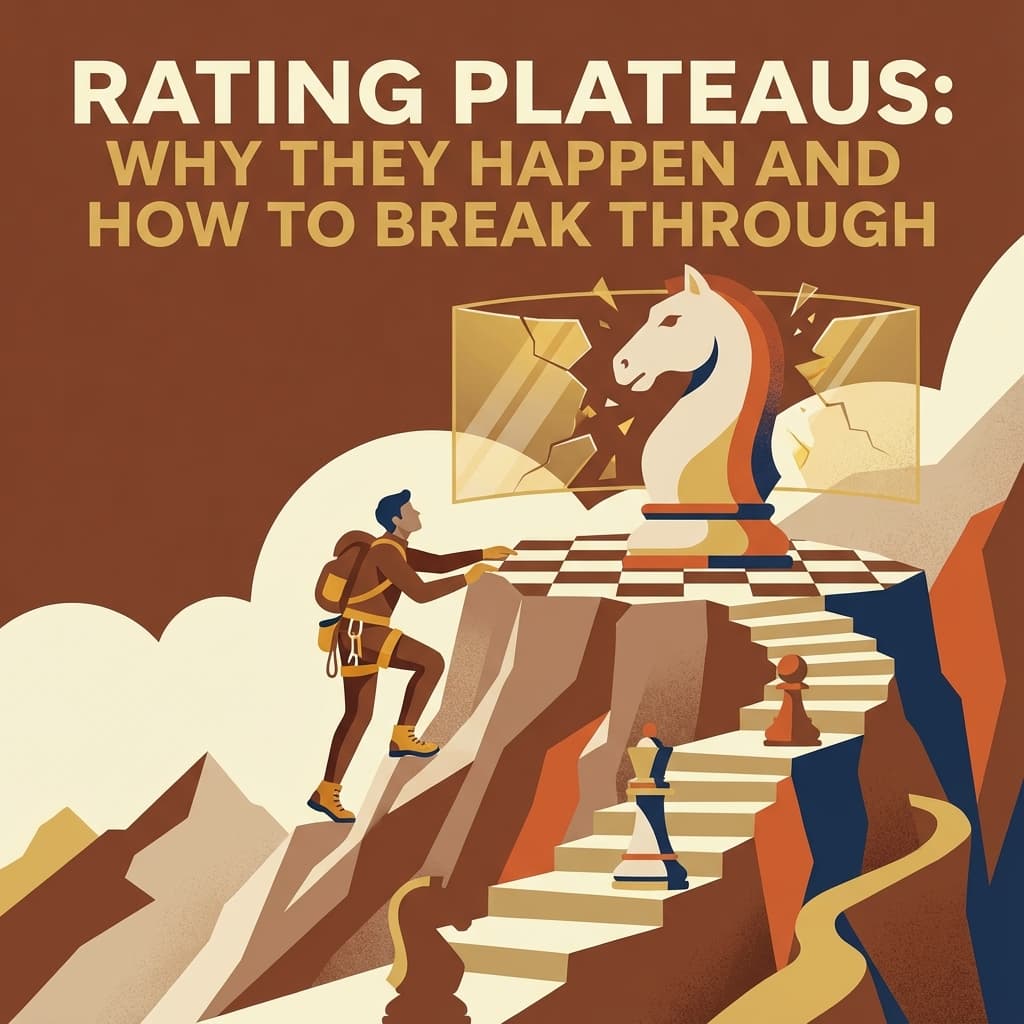
Rating Plateaus: Why They Happen and How to Break Through
Six months ago, you reached 1400. Today, you’re still 1400, give or take 30 points. You study, you play, you analyze, yet your rating graph barely moves.
Welcome to the plateau, one of the most frustrating phases in chess improvement.
But here’s the key: plateaus are not failures. They are natural, predictable stages where your current skills consolidate before the next jump. Understanding why they happen, and applying the right corrections, is the fastest path to your breakthrough.
This guide explains why plateaus occur and gives you proven, practical methods to push past them.
1. The Anatomy of a Plateau
Consolidation vs. Stagnation:
- Consolidation: Your brain is wiring new concepts. You aren't gaining rating, but your play is becoming more stable. This is good.
- Stagnation: You are repeating the same mistakes and reinforcing bad habits. This is bad.
The Sign: If you feel like you understand more but play the same, it's consolidation. If you feel stuck and bored, it's stagnation.
2. The "Knowledge vs. Skill" Gap
The Problem: You know about weak squares, but you don't exploit them in games. You know about opposition, but you blunder it in time trouble.
The Reality: Passive knowledge does not win games. Active skill does.
The Fix: Stop learning new things. Start practicing what you already know until it becomes automatic.
3. Identifying the Bottleneck
The Weakest Link: Your rating is determined by your worst skill, not your best. You might have 1800-level openings but 1200-level endgames. You will remain 1200.
The Audit: Look at your last 20 losses.
- Did you blunder tactics?
- Did you get crushed in the opening?
- Did you lose equal endgames?
Focus: Dedicate 80% of your study time to that one bottleneck.
4. The "Shock" Method
Change the Stimulus: If your current routine isn't working, change it drastically.
Examples:
- Stop playing blitz: Switch to only Rapid for a month.
- Change openings: Play something uncomfortable to force your brain to think.
- Take a break: Step away from chess for a week. Let your brain reset.
5. The Role of Coaching
The External View: It is almost impossible to see your own plateau causes objectively. You are too close to the problem.
The Breakthrough: A coach can look at your games and say, "You aren't stuck because of tactics; you're stuck because you trade pieces too early." That one insight can save you months of frustration.
The Solution: Platforms like findyourchesscoach connect you with mentors who specialize in breaking plateaus. They provide the personalized roadmap you need to turn your stagnation into your next big leap.
Conclusion: A plateau is just a resting place on the mountain. Don't set up camp there. Adjust your pack, check your map, and keep climbing.
Ready to Take Your Chess to the Next Level?
Find experienced chess coaches who can help you master the concepts in this article and accelerate your improvement.
Browse Chess CoachesAbout the Author
Find Your Chess Coach ©
The Find Your Chess Coach team consists of chess enthusiasts, developers, and coaches dedicated to connecting players with the best instructors worldwide. We curate content to help chess players improve and find their perfect coaching match.