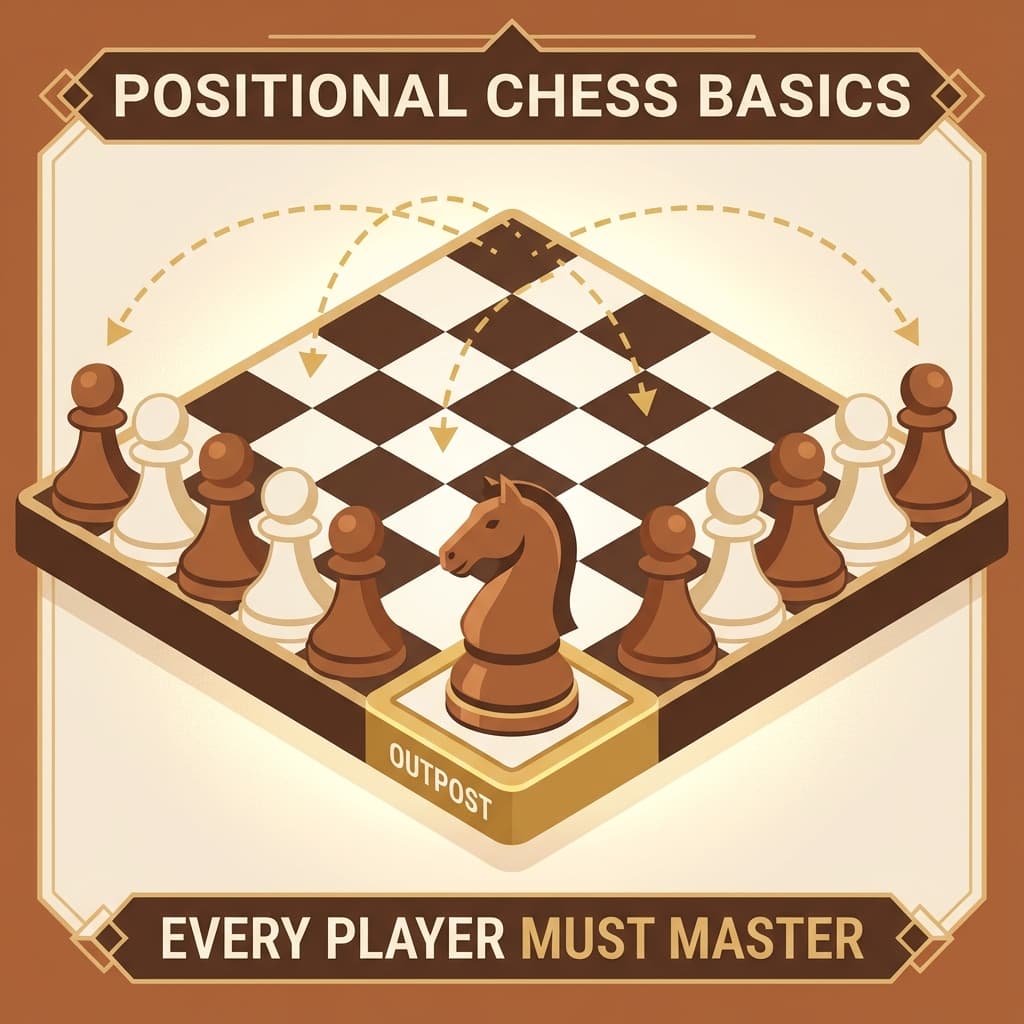
Positional Chess Basics Every Player Must Master
Tactics win games, but strategy saves them. You can be a tactical genius, but if your pieces are on the wrong squares, you will never get the chance to use your skills.
Positional chess is the art of improving your position slowly, creating small advantages that accumulate until your opponent collapses. It is what separates the 1200 player who hopes for a blunder from the 1800 player who forces one.
This guide covers the fundamental positional concepts that will transform your understanding of the game.
1. Weak Squares: The Outpost
Definition: A square that cannot be defended by a pawn.
The Goal: Identify weak squares in your opponent's camp and plant a piece (usually a knight) on them.
Why it matters: A knight on an outpost is a monster. It controls key squares, attacks enemy pieces, and cannot be easily driven away. It is often worth more than a rook.
2. Pawn Structure: The Skeleton
Pawn Islands: The fewer, the better. Each separate group of pawns requires its own defense. If you have 3 islands and your opponent has 2, you have more targets to defend in the endgame.
Doubled Pawns: Usually a weakness because they cannot defend each other and are hard to move. However, they can sometimes control important squares or open files for rooks.
Backward Pawns: A pawn that has fallen behind its neighbors and cannot be defended by them. It is a permanent target.
3. Piece Activity: Good vs. Bad Bishops
The Rule: A bishop is "good" if its pawns are on the opposite color of the bishop. It is "bad" if its pawns are on the same color, blocking its movement.
The Strategy:
- If you have a bad bishop: Trade it for an enemy piece or get your pawns off its color.
- If your opponent has a bad bishop: Keep the position closed and restrict their movement. You are effectively playing a piece up.
4. Prophylaxis: Stopping the Plan
The Question: Before you move, ask: "What does my opponent want to do?"
The Action: If they want to push a pawn, stop it. If they want to bring a knight to f5, control that square. Frustrating your opponent's plans is often more effective than creating your own.
5. Learning Positional Chess
The Challenge: Tactics are easy to practice (puzzles). Strategy is harder because the "answer" is often a plan, not a move.
The Solution: You need a guide to explain the why behind the moves. A coach can look at your games and explain that you lost not because of a blunder, but because you allowed your opponent to dominate the light squares.
Find Your Mentor: Platforms like findyourchesscoach connect you with strategic experts who can teach you to read the board like a map, turning you from a reactive player into a positional master.
Conclusion: Positional chess is not boring; it is sophisticated. Master these basics, and you will win games without ever needing a tactical miracle.
Ready to Take Your Chess to the Next Level?
Find experienced chess coaches who can help you master the concepts in this article and accelerate your improvement.
Browse Chess CoachesAbout the Author
Find Your Chess Coach ©
The Find Your Chess Coach team consists of chess enthusiasts, developers, and coaches dedicated to connecting players with the best instructors worldwide. We curate content to help chess players improve and find their perfect coaching match.